

 Home /
Table of Contents

Contact Us
Updated 1 month ago
Coffee Roaster | Core Design Principles and Practical Roasting Techniques

COFFEE ROASTER
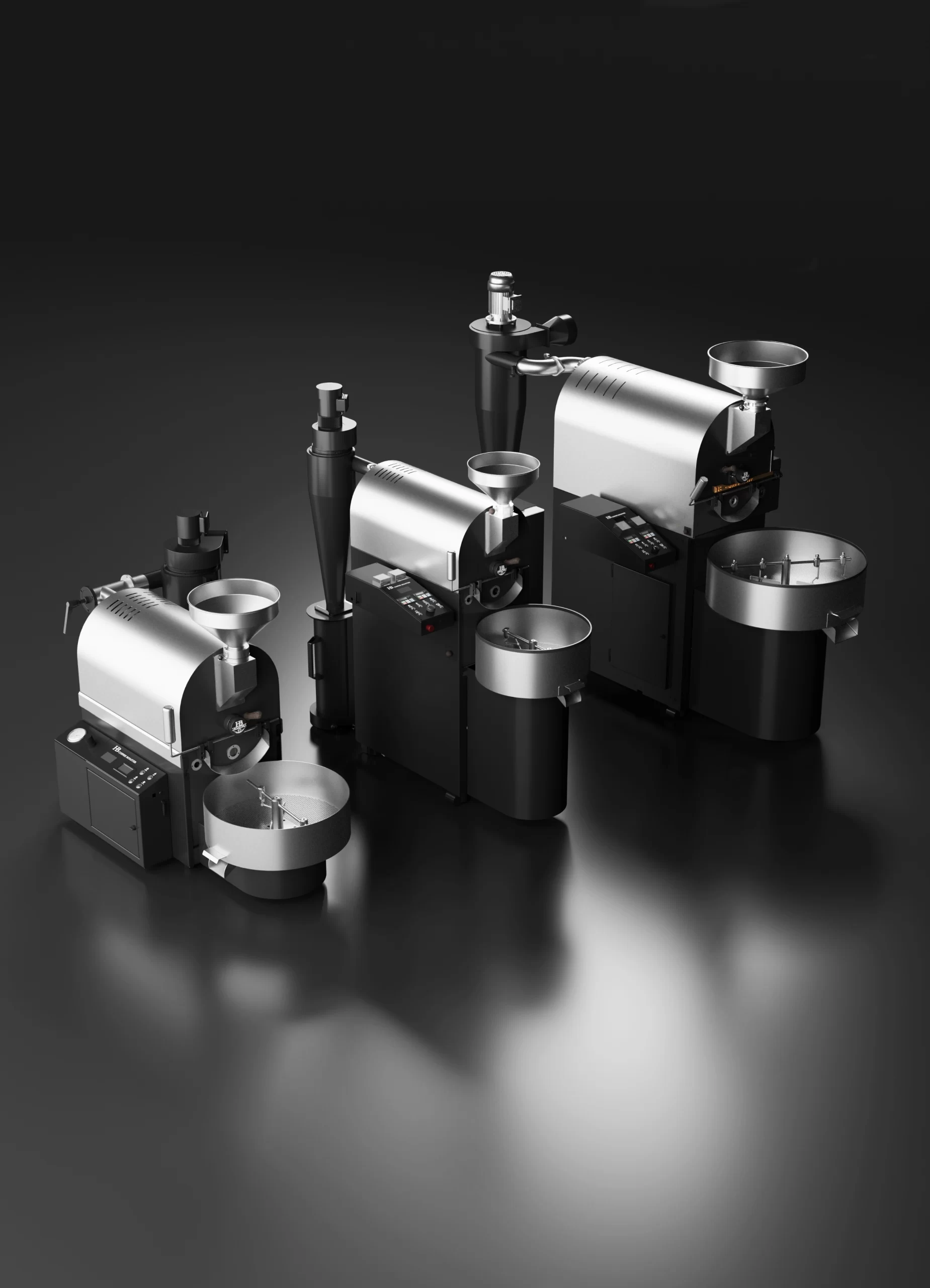
HB COFFEE ROASTER, founded in 2008, is a pioneer in China’s coffee roaster development. With strong industrial manufacturing expertise and deep coffee insights, HB designs and produces professional coffee roasting machines with stable performance and reliable quality. Based in Ningbo, HB SPACE 2.0 integrates design, software development, machining, assembly, and manufacturing capabilities to ensure full-process quality control from R&D to delivery.
March 18, 2026
The Essence of Coffee Roasting
Half lies in the green coffee beans
Half lies in the coffee roaster
A good coffee roaster can maximize the flavor potential of green coffee beans;
Only by understanding the underlying logic of a coffee roaster can you truly control the roasting curve and produce consistently excellent coffee.
This article is excerpted from the coffee podcast “Coffee Chat” by Coffee Rookie × Slightly Fat Roaster × HB Lu Haoyuan.
It will be divided into two parts, focusing on the underlying principles and basic practical techniques of coffee roasters, including the three core methods of heat transfer, the differences between electric and gas coffee roasters, and selection techniques.
These are essential technical insights that every professional roaster should understand.
1. Core Heat Transfer in Coffee Roasting:
Understanding These Three Principles Is the First Step to Mastery
The essence of coffee roasting is the interaction between heat and coffee beans.
The heat transfer process in a coffee roaster mainly relies on three methods:
heat conduction, heat convection, and heat radiation.
These three methods are also the key factors determining roasting uniformity.
Many roasting problems originate from an imbalance in controlling these three forms of heat transfer.
Heat Conduction
‹ Mainly Through the Drum ›
Heat transfer occurs when coffee beans come into contact with the drum.
The heat needs to penetrate through the entire coffee bean. If the drum temperature is much higher than the hot air temperature, it can easily cause uneven roasting inside the coffee beans.
The mainstream drum materials include:
- Cast iron
- Cast steel
- Carbon steel
The three materials have similar heat storage capabilities, but their thermal conductivity differs significantly, directly affecting the efficiency of heat absorption by coffee beans.
Many people believe:
“The thicker the drum, the better; the faster the heat conduction, the better.”
This is actually incorrect.
What happens if heat conduction is too fast?
- Contact point temperature rises instantly → local scorching
- The inside is not fully developed → the outside burns first
For example:
Copper has extremely high thermal conductivity.
However, if copper were used to manufacture a roasting drum: The result would be that the thermal conductivity is too high, causing the drum to overheat and scorch the coffee beans. Therefore, what truly matters is the “balance” of heat conduction, not “the faster, the better.”
Heat Convection
‹ Provided by Hot Air ›
Hot air surrounds the coffee beans and transfers heat.
Only half of the coffee bean needs to be heated through conduction for the internal temperature to rise, making convection heat a key factor in improving roasting uniformity.
The core function of the paddles is to disperse coffee beans and allow hot air to penetrate throughout the entire drum.
The paddle angle and rotation speed determine the proportion of convection heat involved:
The faster the rotation speed, the longer the coffee beans remain suspended in the air, increasing contact with hot air and raising the proportion of convection heat.
Conversely, slower rotation increases the proportion of conduction heat.
So, does a faster drum speed always mean better roasting?
Many beginners may constantly adjust the drum speed, but the problem is:
Too fast → coffee beans stick to the drum wall → suspension time actually decreases
The real key is:
Finding the most suitable rotation speed that allows coffee beans to be lifted and thrown as much as possible.
Because:
Longer suspension time
→ Higher convection ratio
→ Cleaner flavor
Therefore, the paddle design inside the roasting machine is extremely important.
Practical tip:
To determine whether a paddle design is excellent, observe the condition of the beans when they are discharged. If the beans rush out all at once, it indicates that roasting mainly occurs at the front part of the drum.
If the beans roll down layer by layer, it means the paddles can evenly disperse the beans back and forth inside the drum.
Heat Radiation
‹ Invisible Heat Energy ›
Heat radiation is a wavelength-related physical phenomenon.
It generates different wavelengths of infrared radiation (far infrared / near infrared) depending on the temperature of the material.
As a fixed medium, coffee beans also have different penetration capabilities for different wavelengths.
The faster the rotation speed, the longer the coffee beans remain suspended, increasing their contact with hot air and raising the proportion of convection heat.
Conversely, slower rotation increases the proportion of conduction heat.
Many people believe:
“Heat radiation can penetrate the drum and directly act on the coffee beans.”
This is actually incorrect.
↓
Heat radiation cannot penetrate metal. Instead, it acts on the metal itself — heating the drum, which then transfers heat through radiation.
To make radiation effectively act on coffee beans, it is necessary to accurately calculate the matching relationship between coffee bean density and infrared wavelength.
This is extremely difficult to control in practical applications.
Therefore, radiation exists, but it is not the dominant heat transfer method.
2. Electric Heating VS Gas Coffee Roasters: What Are the Differences? How Should You Choose?
Electric heating and gas are the two most common heat sources used in coffee roasters.
Neither has an absolute advantage over the other.
The key depends on the application environment, operational requirements, and usage conditions.
The core differences and practical considerations are explained below:
Gas Coffee Roasters: Direct Heat Response, Requires Control of Heat Uniformity
The mainstream gas heating methods include:
- Gas burners
- Lotus burners
In earlier designs, far-infrared ceramic plates were also used.
Gas burner:
Provides more even heat distribution and is currently the mainstream choice.
Lotus burner:
Offers more flexible heat adjustment, but overlapping areas between multiple burners can create concentrated heat zones, causing uneven heating of the drum.
Ceramic plate:
Provides energy efficiency and high heat utilization.
However, when the heat output is too low, flame movement may occur, causing step-like changes in heat output and reduced stability.
Core Advantages:
The heat response is direct and intuitive.
With visible flames, roasters can more easily perceive changes in heat intensity.
Limitations:
Gas combustion produces water vapor, which changes the humidity inside the roasting environment.
In first-tier cities, gas usage approval procedures are strict.
Liquefied petroleum gas (LPG) also has fluctuations in heating value.
Electric Coffee Roasters: Safe and Convenient, Testing the Design of Heating Elements
The mainstream heating elements include:
- Heating wires
- Heating tubes
- Quartz / carbon fiber / graphene heating tubes
Heating wire:
Provides high efficiency in heating air and a higher proportion of hot air participation.
However, because it directly contacts air, oxidation occurs easily, resulting in the shortest service life.
Heating tube:
Separates the heating wire from air, providing a longer service life.
However, air heating efficiency is lower and requires higher power support.
New-generation heating tubes (quartz / carbon fiber, etc.):
Have a higher proportion of radiant heat and slightly weaker conduction heat.
They are suitable for coffee roasters that focus on radiant heat design.
Core Advantages:
Convenient operation (ready to use after plugging in), higher safety, no combustion reaction, and more stable humidity in the roasting environment.
Limitations:
Heat response is slower.
There is no visible flame for direct observation.
Roasters can only rely on power settings or level displays, placing slightly higher requirements on operational experience.
Key Selection Principles
丨Consider the Environment:
In scenarios such as first-tier cities and commercial stores where gas approval is strict, electric heating is preferred.
For factories and roasting studios with suitable gas conditions, gas roasters can be selected according to roasting habits.
丨Consider Operation Preferences:
Those who prefer intuitive heat control and rapid curve adjustment can choose gas roasters.
Those who prioritize operational safety and stable roasting environments can choose electric roasters.
丨Consider Details:
Gas roasters require attention to heat distribution uniformity.
Electric roasters require attention to heating element lifespan.
Both are affected by energy stability:
- Gas is affected by gas pressure and heating value fluctuations.
- Electric heating is affected by voltage fluctuations.
Practical Tip:
To extend the lifespan of heating elements in electric coffee roasters, never use high heat power with a small airflow setting!
This operation causes heat energy to accumulate inside the machine, resulting in high-temperature oxidation of the heating wires and accelerating aging.
Essentially, it creates dry-burning damage.
Why Does the Machine Heat Up More Slowly and Cool Down More After Maintenance?
Core Cause:
After maintenance, the pipes and airflow system become smoother.
Under the same airflow setting, the exhaust volume becomes larger, causing heat to be removed faster.
Essentially, this is a result of energy conservation.
Solutions:
- Install an airflow pressure gauge to measure the actual exhaust airflow.
After maintenance, adjust the airflow back to the level before maintenance to ensure roasting stability.
- Perform regular maintenance to avoid excessive buildup inside the pipes and prevent sudden airflow changes caused by one-time intensive cleaning.
Q
How Should You Handle Sudden Power Failure During Roasting / When Coffee Beans Are About to Burn?
Core Cause:
Avoid allowing a large amount of fresh air to enter the drum.
Air + high-temperature coffee beans / smoke particles can easily trigger combustion or flash fire.
Solutions:
Small Machines (Home / Small Shop Models):
Remove the coffee beans directly.
Do not start the cooling stirring function, as it will accelerate airflow movement.
Large Machines (Factory / Large Roasting Studio Models):
Do not discharge the beans.
Do not open the airflow damper.
Directly spray water into the drum to extinguish the fire.
(After spraying, the machine must undergo a complete inspection and maintenance.)
Preventive Measures:
HB large coffee roasters are equipped with a manual bean discharge system.
After power failure, coffee beans can be manually removed through the hand-operated discharge device, reducing risks from the source.
5. Coffee Roaster Maintenance and Safe Operation:
Details Determine Equipment Lifespan and Roasting Safety
A coffee roaster is like a car.
Only regular maintenance can keep it in optimal condition.
Safe operation is the bottom line of roasting.
The following are the key points and maintenance schedules that are recommended to be saved for reference.
1 Equipment Maintenance
Performed According to Different Cycles, Focusing on Cleaning and Lubrication
The core purpose of maintenance is to ensure smooth airflow and smooth operation of components.
For coffee roasters with different usage frequencies, maintenance cycles can be adjusted accordingly:
- Factory high-frequency operation: monthly maintenance
- Home / small shop low-frequency operation: quarterly maintenance
Daily Cleaning:
Remove chaff and clean the collection tray to prevent buildup from affecting airflow.
Monthly / Quarterly Maintenance:
Check whether the airflow damper and pipes are unobstructed.
Lubricate motors and bearings.
Clean exhaust pipes.
(Focus on cleaning the pipe sections that are directly exposed to air and cool down the fastest, as these areas are more likely to accumulate condensed smoke particles.)
Lubrication Guidelines:
· Daily Short-Term Lubrication:
Use non-toxic lubricants that comply with food machinery safety certifications.
Direct spraying can be applied.
· Bearing Replacement:
If bearings produce metal friction sounds, do not only perform lubrication.
Direct replacement is recommended.
(The special grease used for coffee roasters is food-grade and high-temperature resistant. It is expensive and has limited availability, making conventional lubrication unable to solve the fundamental problem.)
Core Principle:
A qualified coffee roaster must not only know how to roast coffee beans but also know how to maintain the machine, keeping the equipment always in the best working condition.
2 Safety Operation
Gas / Electric Heating Each Has Different Priorities, But Safety Boundaries Must Never Be Crossed
· Gas Coffee Roaster Safety
1. Install a Gas Alarm:
LPG is heavier than air, so the alarm should be installed near the floor.
Natural gas is lighter than air, so the alarm should be installed at a higher position.
2. Ensure the Roasting Area Has Good Ventilation
Never operate the machine in an enclosed space.
3. Equip the Area with a Carbon Dioxide Fire Extinguisher
Avoid using:
- Foam / water-based extinguishers (risk of electrical leakage)
- Dry powder extinguishers (difficult to clean afterward)
· Electric Coffee Roaster Safety
1. The Machine Must Be Properly Grounded
This prevents electric shock caused by induced current generated during motor operation.
(Without grounding, touching the machine barefoot may result in electric shock.)
2. Avoid Dry-Burning Operation with High Heat Power + Small Airflow
This not only damages the heating elements but also creates the risk of circuit overload.
· General Safety Principles
1. Never Leave the Roasting Area Without Supervision
Prevent coffee beans from becoming over-roasted and catching fire.
2. If Sparks Appear Inside the Drum:
Never open the chamber door.
Never increase the airflow.
The first choice is to contain the flame by limiting oxygen supply.
6. Final Thoughts: Understanding the Machine Is the Key to Truly Understanding Roasting
Coffee roasting has never been a mechanical process of simply “adjusting parameters according to a curve.”
It is a two-way collaboration between the roaster and the machine.
This article focuses on the engineering logic behind coffee roasters — from heat transfer principles to material selection, from heat source design to automation technology.
Every detail affects the final roasting flavor.
For roasters, understanding the underlying principles of a coffee roaster is not about becoming an engineer.
It is about understanding your own machine, maximizing its core advantages, avoiding its inherent limitations, and allowing the machine to become a tool that helps create excellent coffee rather than an obstacle.
The value of a professional coffee roaster also lies in providing roasters with a stable and controllable roasting platform, allowing their experience and creativity to be accurately transformed into the flavor profile of coffee beans.
May every roaster build a deep understanding and connection with their own coffee roaster, and bring out the best flavor potential of every green coffee bean.
Written by
COFFEE ROASTER
COFFEE ROASTER
HB COFFEE ROASTER, founded in 2008, is a pioneer in China’s coffee roaster development. With strong industrial manufacturing expertise and deep coffee insights, HB designs and produces professional coffee roasting machines with stable performance and reliable quality. Based in Ningbo, HB SPACE 2.0 integrates design, software development, machining, assembly, and manufacturing capabilities to ensure full-process quality control from R&D to delivery.
-
Share
-

-

-